A New Era for AI Video in 2026: Fliki’s Silent Acceleration
In 2026, Fliki is rapidly reshaping the landscape of content creation by enabling large-scale, text-based rapid video production; while lowering the barrier to entry for creators worldwide, it also introduces trade-offs between customization and originality, ultimately redefining how videos are produced, distributed, and differentiated in this increasingly competitive digital environment.
Sabir Ahmed
Fliki was created by a small startup team. Sabir Ahmed ...
From the “Timeline” to the “Text Pipeline”
The evolution of AI video tools has entered a new phase—one in which the starting point for creation is no longer the traditional “timeline,” but rather the “text itself.” In recent years, platforms like Lumen5 and Pictory AI have helped streamline content production workflows, but at their core, they still adhere to the familiar traditional editing model. In contrast, Fliki represents a more radical breakthrough, introducing an entirely new workflow: scripts, articles, and raw text are no longer “afterthoughts” in the video production process, but are elevated directly to the cornerstone of video creation.
This shift is by no means limited to the technical level; it reflects a much broader transformation in content production and consumption patterns. As short-form video formats and “ultra-fast release cycles” increasingly dominate major digital platforms, the pursuit of “speed” has, in many scenarios, surpassed the need for “meticulous editing.” Fliki’s operational philosophy aligns perfectly with this reality, offering a highly efficient system that drastically reduces the video production process—which once took hours—to just a few minutes. Through this innovation, Fliki challenges long-held assumptions about what video creation truly requires—a challenge that holds particularly profound significance for independent creators operating outside the traditional media ecosystem.
The Rise of Fliki: Simplicity, Scalability, and Strategic Timing
Fliki’s rapid rise is inextricably linked to its strategic positioning in the increasingly crowded AI space. While competitors like Synthesia focus on corporate presentation creation and HeyGen emphasizes avatar-based storytelling, Fliki has carved out a unique niche centered on “ease of use” and “efficiency.” Its core value proposition is straightforward and clear: regardless of a user’s technical proficiency, anyone can transform plain text into dynamic video content with minimal effort and a very low barrier to entry.
Amid Fliki’s strong growth momentum, “timing” has also played a crucial role. As businesses and independent creators alike seek video production solutions capable of “scalable production,” tools that effectively lower the barrier to entry are quickly gaining market favor and attention. With its multilingual support, AI-generated voice-over capabilities, and automated scene-building features, Fliki has successfully positioned itself as a practical solution for global content distribution. This perfect blend of “simplicity and ease of use” with “scalable production capabilities” makes Fliki particularly attractive in regions where traditional video production resources are relatively scarce but demand for video content continues to soar.
Capabilities and Limitations: The Trade-offs Behind Efficiency
Fliki’s core competitive advantage lies in its built-in, highly integrated suite of features—a suite meticulously designed to achieve the goal of “blazing-fast content output.” Users can input blog posts, scripts, or creative ideas, and the system then transforms them into structured scenes, automatically adding subtitles, stock footage, and AI-generated narration. The platform’s voice library is one of its most significant strengths, offering a rich variety of tones and accents that allow users to tailor content to different audiences without the need for additional recording.
However, this efficiency comes with certain trade-offs, which constitute the platform’s limitations. Fliki cannot generate original visual content but relies on existing stock footage; this footage can sometimes feel repetitive or fail to align well with the narrative. Its editing controls are also relatively basic, limiting users’ ability to make fine-tuned adjustments to transitions, narrative pacing, or visual style. These limitations highlight a core tension faced by AI-driven tools: the balance between automation and creative control. In Fliki’s case, the focus clearly leans toward automation, which may not satisfy users who seek a hands-on, deeply immersive creative experience.
Industry Impact: Redefining the Creator Community—and How Content Is Created
Fliki’s far-reaching impact extends far beyond its features alone, touching on fundamental issues regarding “creator identity” and “content production” in the digital age. By lowering the barriers to video creation, it has effectively expanded the pool of potential creators. Today, bloggers, marketers, educators, and small and medium-sized businesses can produce video content without having to invest significant time in mastering professional skills or purchasing expensive equipment, thereby reshaping the competitive landscape of online media.
At the same time, this trend toward the “democratization of creation” has brought new challenges. As more creators adopt automated video production tools, content output continues to surge, intensifying the competition for audience attention. In this environment, it has become increasingly difficult to differentiate content—especially when so many videos rely on similar stock footage and templates. Consequently, Fliki’s impact is twofold: while it accelerates content production, it also intensifies the demand for originality. In the context of 2026, the question is no longer “Can we produce videos quickly?” but rather, when “quick production” becomes the norm, how exactly can creators stand out from the crowd.
Fliki — Interface Screenshots
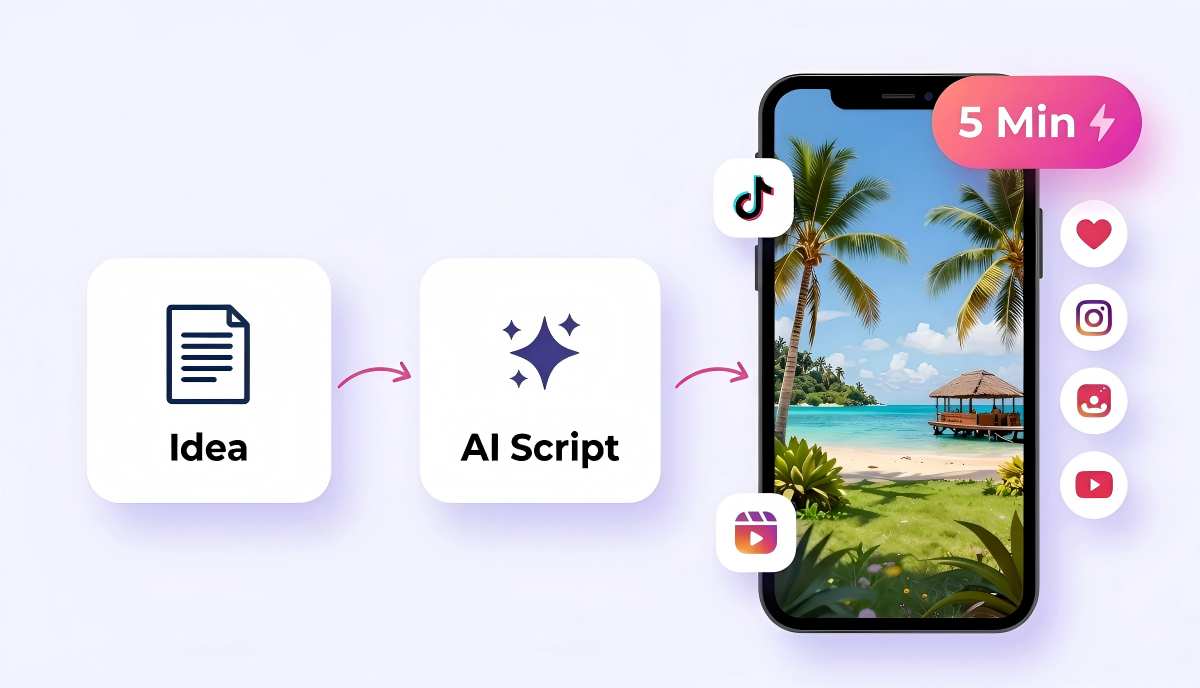
Create Viral TikTok and Reels Videos Without Showing Your Face
1 / 4About Sabir Ahmed
Fliki was created by a small startup team. Sabir Ahmed is widely regarded as one of Fliki’s core founders, while Atul Yadav is a key founder and an engineer-entrepreneur with a strong technical background. This small team began developing Fliki around 2021–2022, and the company is registered in Delaware, USA. Fliki’s development philosophy is clear: it is a classic “lean team + AI-powered tool” startup, focused on drastically simplifying the text-to-video and voice generation processes to serve content creators and marketers.
Clicking “Visit Official Site” takes you to Fliki's website. Pricing and features may have changed since this review was published.
Discussion(0 comments)
No comments yet. Be the first to share your thoughts!
You Might Also Like
More Video AI tools worth your time
Runway Gen-3 Review: The Best AI Video Generator for Creators
Runway Gen-3 Alpha has transformed AI video generation. We tested it for 30 days across filmmaking, marketing, and social media content creation.

OpenAI Sora Review 2026: The Most Realistic AI Video Generator
Sora can generate up to 60-second videos with stunning physical accuracy. We test whether it lives up to the hype and how it compares to Runway and Kling.
HeyGen Review 2026: The Best AI Avatar Video Creator
HeyGen lets you create professional talking-head videos with AI avatars. We test it for marketing, training, and social media content creation.