OpenClaw 2026:An AI Agent of Real Action, Not Just Empty Talk
OpenClaw is an open-source AI agent whose capabilities extend far beyond simple conversational interactions; it can actively execute tasks such as managing emails, orchestrating workflows, and interacting with various applications. In 2026, it stands out thanks to its high degree of autonomy and its "local-first" design philosophy.

Peter Steinberger
Peter Steinberg is an Austrian software developer, entr...
1. What is OpenClaw—and Why Is Everyone Talking About It?
If you’ve been keeping an eye on AI trends for 2026, you’ve likely noticed a shift: AI tools are no longer just answering questions—they are starting to take action. This is precisely where OpenClaw comes into the picture. OpenClaw is an open-source AI agent designed to function like a true "digital assistant," rather than merely a chatbot. Instead of passively waiting for commands, it actively manages a wide range of tasks—such as clearing your inbox, sending emails, organizing your schedule, and even interacting with various applications.
Moreover, all of these operations can be carried out directly on the instant messaging platforms you use every day. What enables OpenClaw to stand out is, at its core, its unique nature as an "agent." Unlike traditional AI tools, OpenClaw does not merely generate text; it is capable of observing, making decisions, and executing tasks. It is precisely this fundamental shift that has allowed it to rapidly become one of the most talked-about AI projects of the year.
2. How It Works—From Chat Messages to Concrete Actions
On the surface, the experience of using OpenClaw is remarkably simple. You merely send a message—much as you would in a chat on WhatsApp or Slack—and the AI takes care of the rest. Behind the scenes, however, an operation far more powerful than what meets the eye is quietly unfolding. OpenClaw taps into large language models (such as GPT or Claude), combining their intelligence with system-level operational privileges. It can browse the web, execute system commands, edit files, and even interact with external services—all driven entirely by natural language instructions.
In terms of practical application, this means you can issue a command such as: "Summarize today's emails and reply to the urgent ones." In this scenario, it will not merely explain *how* to perform these actions; instead, it will directly proceed to carry out the tasks itself. It is precisely this seamless fusion of "reasoning ability + execution capability" that fundamentally distinguishes AI agents like OpenClaw from traditional assistive tools.
3. How exactly does OpenClaw differ from other AI tools?
Ultimately, the most significant difference between the two lies in their "autonomy" and "level of integration." Most AI tools tend to be confined to a specific application, whereas OpenClaw is ubiquitous—deeply embedded within your chat apps, operating system, and every facet of your daily workflow. Furthermore, it operates locally by default, meaning your data remains on your device rather than being transmitted entirely to external servers.
Moreover, it supports plugins, persistent memory, and multi-application integration, enabling it to evolve from a single-purpose tool into something more akin to a "personal operating system." However, this flexibility comes with corresponding trade-offs. Because OpenClaw has the ability to access files, execute scripts, and control the system, it introduces tangible security considerations. Recent reports indicate that if permission management is not handled with care, risks such as unintended operations or data breaches could arise.
4. Is OpenClaw Worth Watching in 2026?
To be frank: OpenClaw is indeed powerful—but it isn't exactly "plug-and-play" for everyone. If you are expecting a simple, polished application experience, you might feel a bit overwhelmed upon your first encounter. However, if you are seeking automation capabilities that go beyond basic commands—that is, a tool that truly works *for* you—then OpenClaw stands as one of the most exciting tools currently available on the market.
It represents a distinct transformation within the field of artificial intelligence: a shift from passive assistant to active collaborator. In 2026, this transformation is pivotal. OpenClaw is not merely another ordinary AI tool; rather, it offers us a glimpse into what the future of personal computing will look like when AI is no longer confined to simply "answering questions," but begins to truly "get things done."
OpenClaw — Interface Screenshots
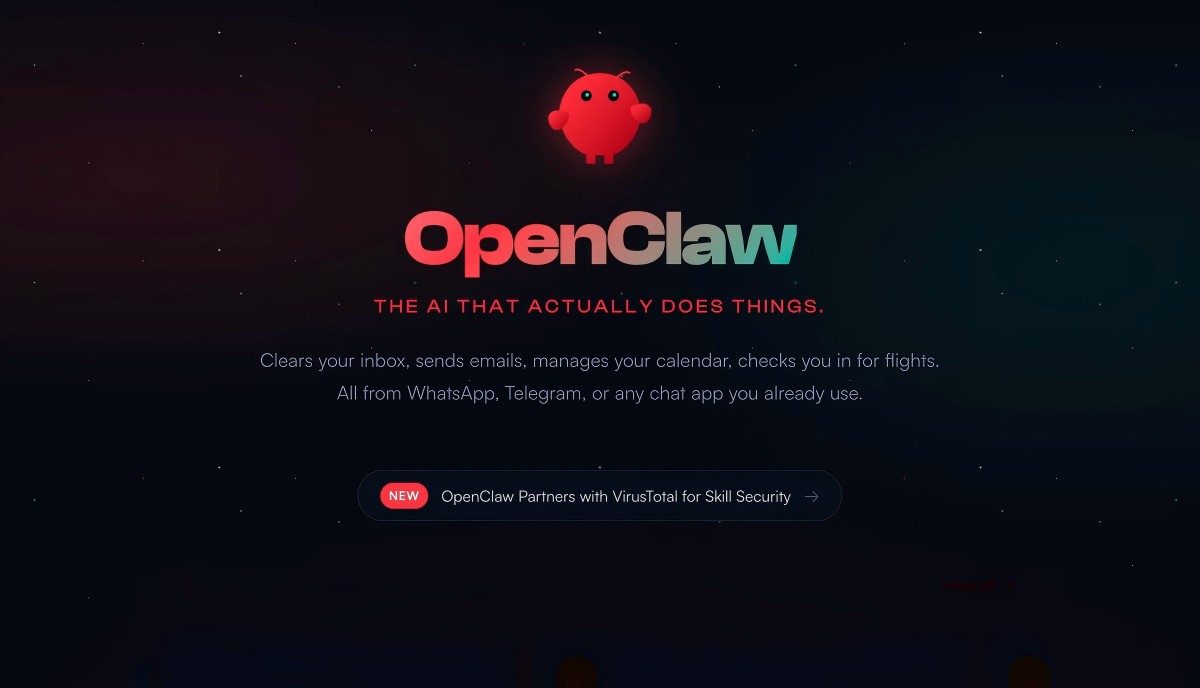
AI That Truly Gets Things Done
1 / 4About Peter Steinberger
Peter Steinberg is an Austrian software developer, entrepreneur, and marketer. He is the founder of the open-source AI agent OpenClaw.
Clicking “Visit Official Site” takes you to OpenClaw's website. Pricing and features may have changed since this review was published.
Discussion(0 comments)
No comments yet. Be the first to share your thoughts!
You Might Also Like
More Guide AI tools worth your time

The 20 Best AI Tools of 2026: The Ultimate Guide
We've tested over 200 AI tools in 2026. Here are the 20 that actually deliver on their promises — ranked by category, use case, and value for money.

Prompt Engineering Guide 2026: Get 10x Better Results from Any AI
The difference between mediocre and exceptional AI output is your prompt. We share the exact techniques used by AI power users to get consistently great results.